
Most Americans believe they have a good grasp on their money. And on the surface, the numbers back that up. More than half (51%) say they feel extremely or very confident managing their finances. But that confidence doesn’t always translate into clarity. (YouGov, Financial Confidence & Independence, Jan 17, 2025)
When consumers encounter unfamiliar offerings with complicated terminology, they hesitate. Research shows that when people don’t fully understand a financial product, they’re far less likely to engage with it.
Annuities are a clear example. According to a 2024 survey, 79% of American adults can’t correctly identify what an annuity is, and only 19% can define it accurately. (Policy Genius, Roughly 4 out of 5 American adults don’t know what an annuity is, July 16, 2024)
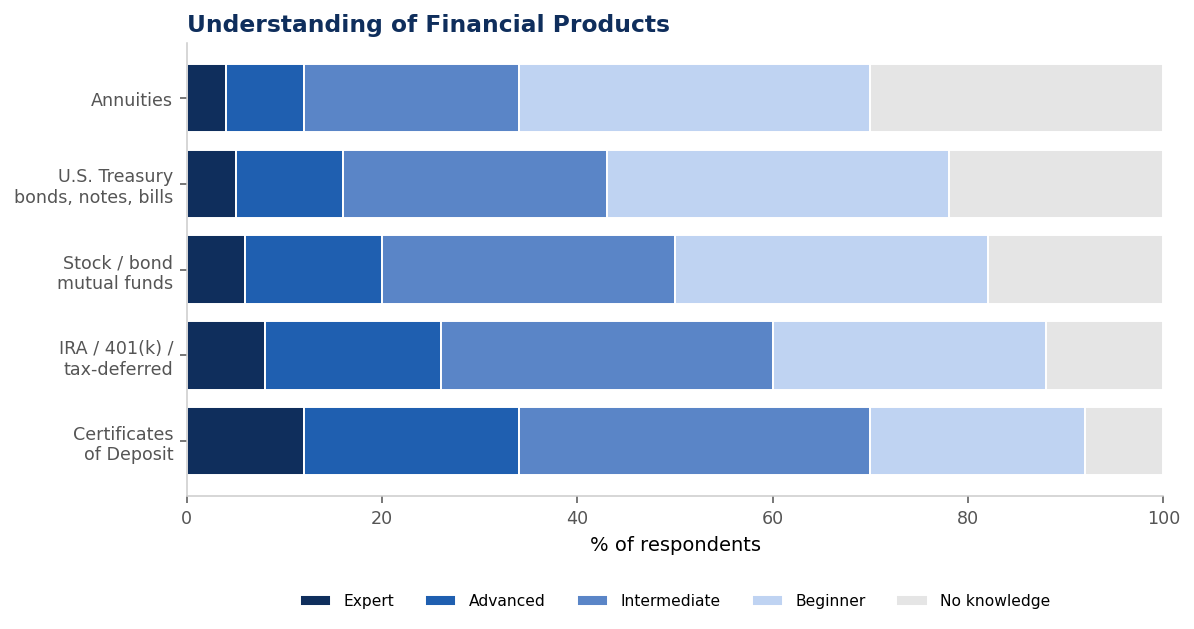
Source: YouGov [Alt text: YouGov chart comparing Americans’ understanding of financial products]
This widespread confusion often stems from how finance topics are explained. Guidance often relies on dense terms or technical phrasing that’s hard to interpret. When information is presented in a way that’s tough to follow, investors struggle to see the value in the product. (CBS News, Personal finance advice doesn't work for most Americans, economists say, December 2, 2025)
That combination of limited familiarity and hard-to-follow explanations creates a real barrier. Many people aren’t sure how annuities work or how to compare options. So they often step back or choose options that feel easier to evaluate. That hesitation slows broader engagement with annuities.
This gap between confidence and understanding creates both a challenge and an opportunity for the financial industry. Investors aren’t asking for more choices or more sophisticated strategies. They want simplicity in product design and communication.
This is especially true for the no-fuss investor, who values clarity and predictability. They want to understand how a product works and how it fits into their retirement plan. When information is easy to follow, simplicity removes friction and helps them make decisions with confidence. That clarity makes it easier to understand how annuities support long-term planning and why simplicity matters in the decision process.
Why consumers gravitate toward familiar products
People gravitate toward financial products that feel simple and predictable. More households are choosing certificates of deposit (CDs), with ownership rising from 11% in 2022 to 15% in 2024. This shift shows a growing interest in fixed-rate products that offer guaranteed returns. (RFI Global, From debt to deposits: How US households are responding to rates, July 7, 2025)
Americans view CDs as straightforward and low risk because they offer fixed interest rates, predictable returns, and FDIC insurance. These features create a sense of consistency and emotional safety around their money.
Nearly three in four investors choose CDs for their low-risk profile, showing that comfort and consistency often matter most in investment decisions. (YouGov, Financial Confidence & Independence, Jan 17, 2025)
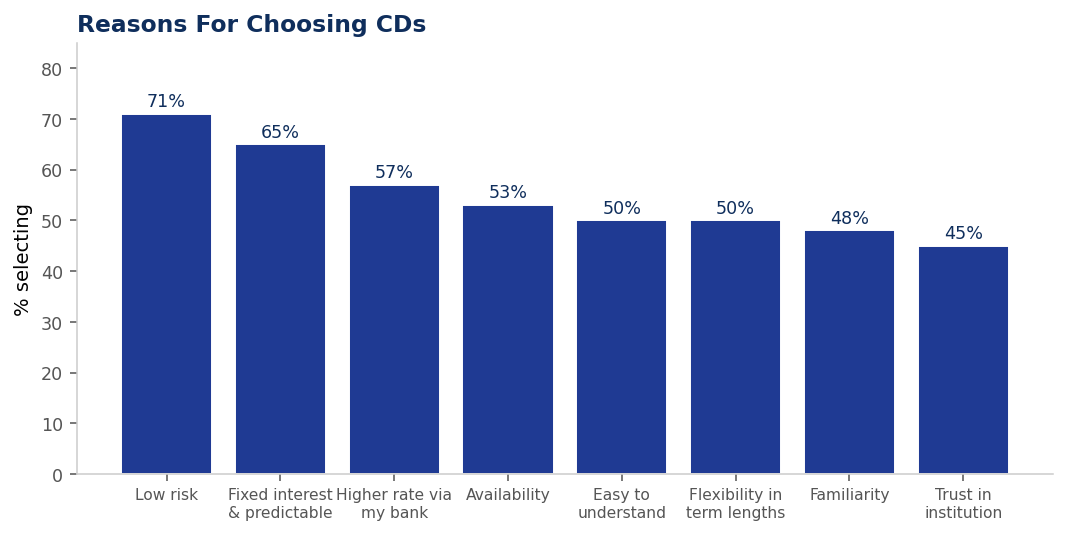
Source: YouGov [Alt text: YouGov bar chart showing the top reasons people choose CDs]
CDs are often viewed as simpler and less risky because they’re easy to evaluate at a glance. Their fixed rates, clear terms, and guaranteed returns make them feel straightforward and dependable. Annuities, on the other hand, are often seen as confusing. Even experienced investors find them complex and think they require more research. (YouGov, Financial Confidence & Independence, Jan 17, 2025)
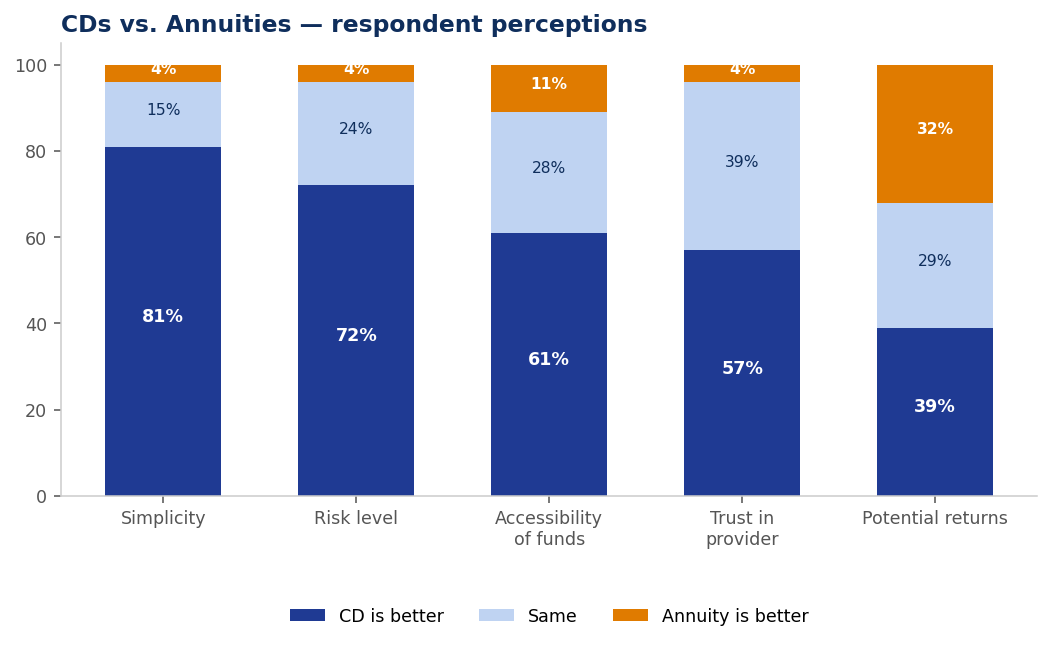
Source: YouGov [Alt text: YouGov bar chart comparing CDs and annuities across six factors]
Note that the chart above reflects survey respondents’ perceptions, not an objective product comparison. CDs and fixed annuities differ materially in guarantor (FDIC vs. issuing insurance company), tax treatment, liquidity (CD early-withdrawal penalty vs. annuity surrender charge and 10% federal tax on pre-59½ withdrawals), and available features (e.g., lifetime income options).
When investment outcomes are easy to understand and predict, they reduce uncertainty and help people feel more in control of their decisions. That clarity builds trust, and decisions feel less stressful.
Transparency and reputation over rates
Competitive rates may catch the eye, but they might not close the deal alone. When choosing financial products, investors care more about trust and clarity than chasing the highest returns.
Nearly 90% of Americans say fee transparency is extremely or very important, and the same number rank reputation and trustworthiness as critical factors in their choices. In fact, reputation now was reported as more influential than competitive rates in driving product selection in this survey. (YouGov, Financial Confidence & Independence, Jan 17, 2025)
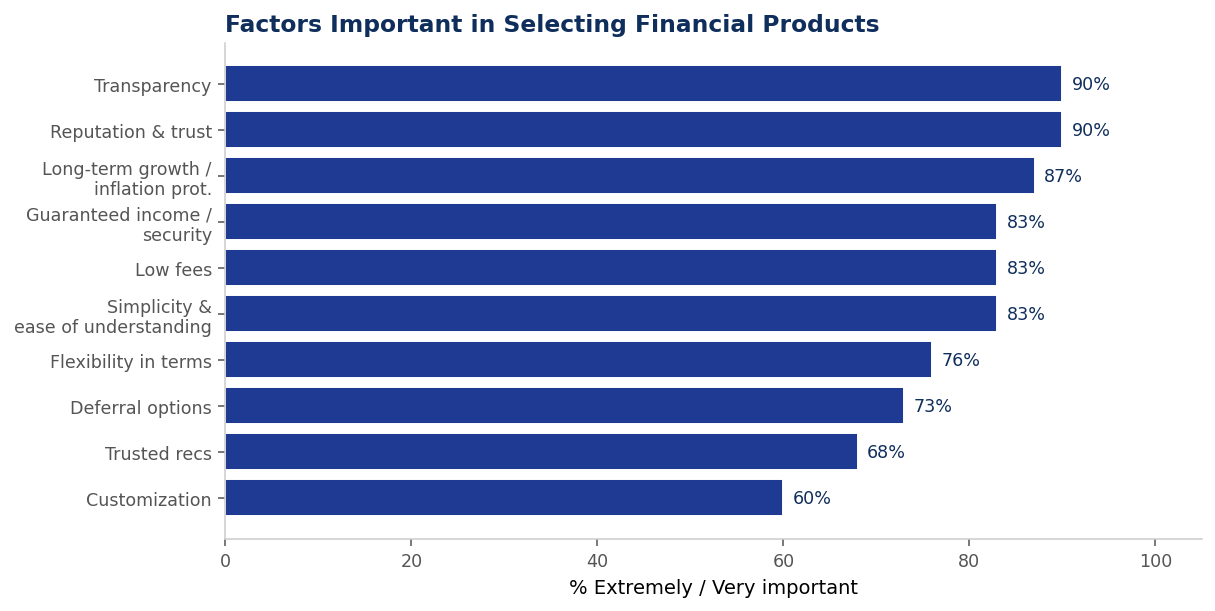
Source: YouGov [Alt text: YouGov chart showing which factors matter most when selecting financial products]
Transparency and simplicity go hand in hand. When savings and investment products have clear terms and upfront pricing, people know what to expect. This reduces stress and removes the fear of hidden costs. It also empowers consumers to make informed, confident decisions.
Investors want to know what they’re signing up for. Companies that provide that clarity earn loyalty and adoption more than those who simply tout high returns.
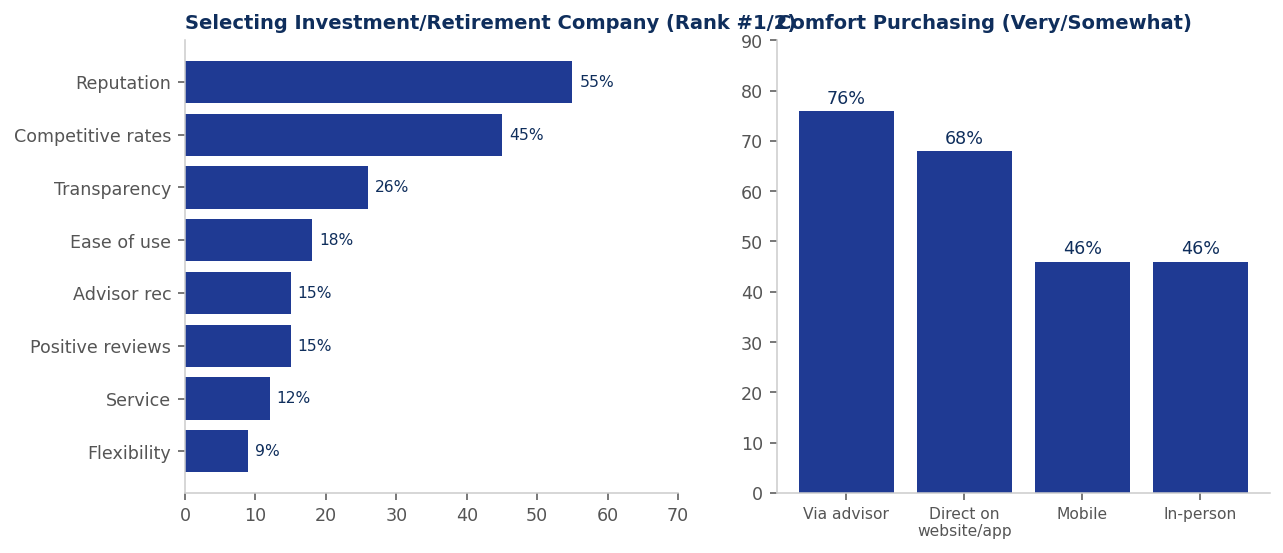
Source: YouGov [Alt text: YouGov chart showing what people look for in retirement companies]
The complexity barrier in annuities
Many consumers never consider annuities at all. Fifty-seven percent of Americans report they haven’t explored them, in part because the products feel unfamiliar.
Nearly half (45%) say they need more information before feeling comfortable with annuities, and almost the same number see them as costly or confusing. This combination of limited awareness and perceived difficulty keeps countless consumers from engaging. (YouGov, Financial Confidence & Independence, Jan 17, 2025)
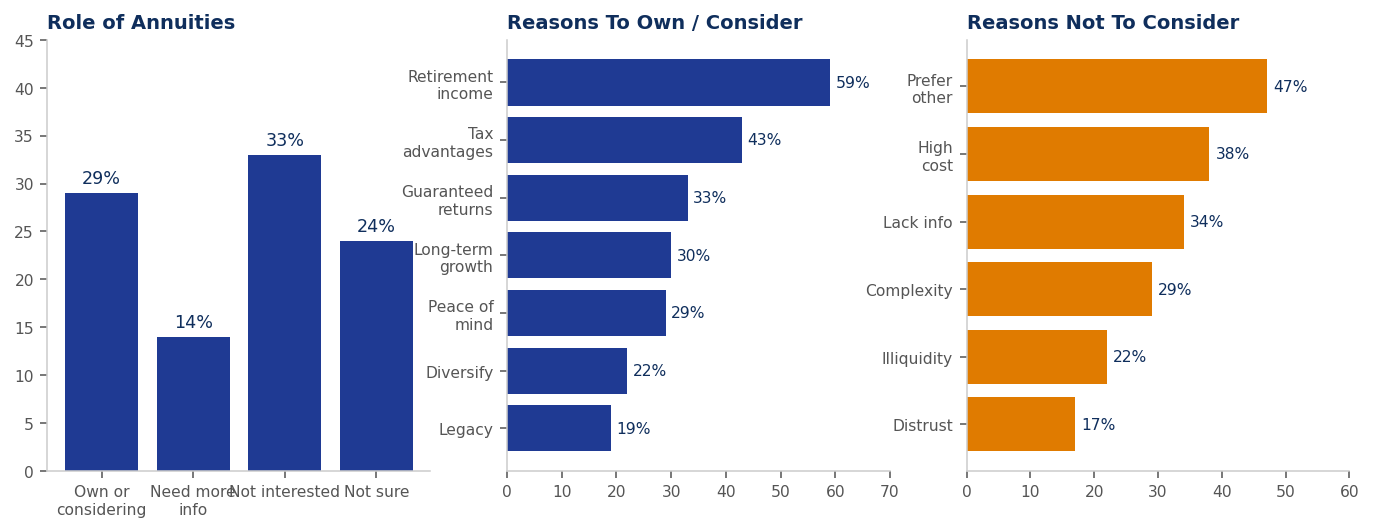
Source: YouGov [Alt text: YouGov chart showing how people view annuities]
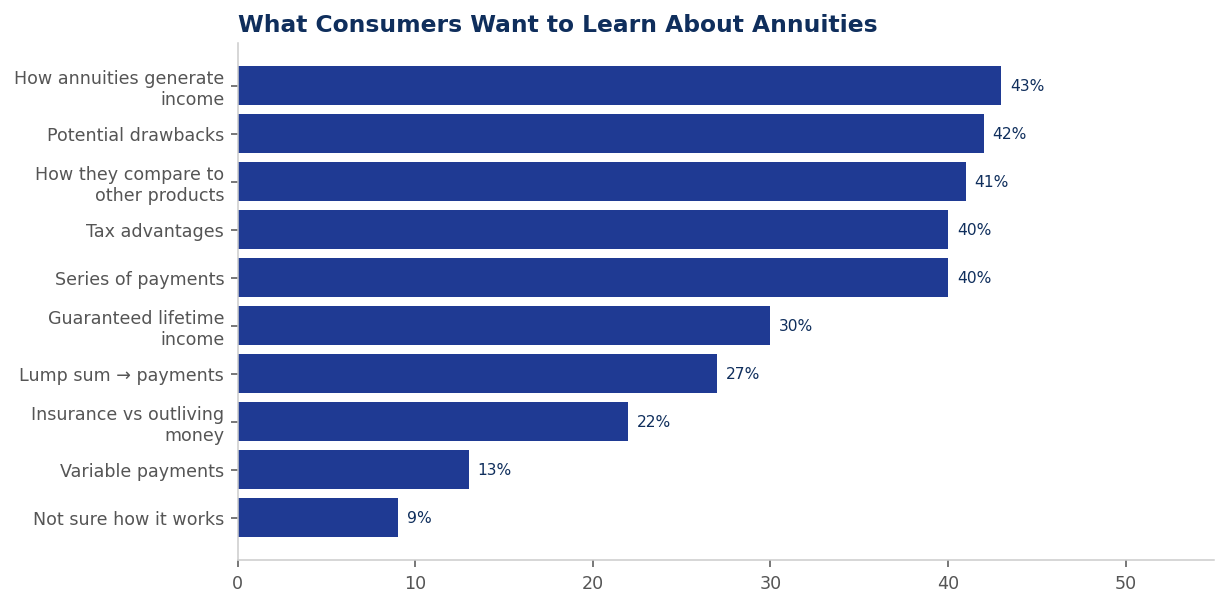
Source: YouGov [Alt text: YouGov chart showing how savers understand annuities and what they want to learn]
Complexity creates hesitation and leaves a gap between what’s available and what people actually understand. Research in decision science shows that as the number of possible outcomes increases, choices become more complex, and people are less likely to select those options, regardless of their benefits. They naturally avoid the cognitive effort required to evaluate it. (ScienceDirect, Complexity aversion in risky choices and valuations: Moderators and possible causes, January 2024)
But interest is growing. Annuities have surged in popularity, driven by demand for guaranteed retirement income and protection from market volatility. This suggests that the main hurdles aren’t lack of interest but confusion around how annuities work. (Investopedia, Interest in Annuities Is Soaring: Understanding the 2025 Trend, June 10, 2025)
Breaking down these barriers requires clear explanations, transparent costs, and approachable guidance. This helps investors move past doubt and negative assumptions, so they can recognize the advantages annuities offer.
What consumers consider when weighing simplicity
Some consumers report a willingness to accept lower potential returns in exchange for products they find easier to understand.
Among Americans aged 35-44, one-third (33%) say they would accept lower returns if it meant the investment was easier to understand. (YouGov, Financial Confidence & Independence, Jan 17, 2025)
Simplicity reduces the mental and manual effort needed to evaluate different options. It eases stress and helps investors move with confidence. And for the “No-Fuss Planner,” understanding the ins and outs of investment opportunities matters more than landing the highest possible returns.
Reframing annuities through clearer information
Annuities aren’t rejected so much as misunderstood.
While 62% of Americans say they have some exposure to annuities, many still feel unsure or unfamiliar about them. When the information available focuses on technical terms or dense descriptions, people find it hard to see annuities as a worthwhile investment. That creates hesitation to explore, even when the underlying benefits are strong. (YouGov, Financial Confidence & Independence, Jan 17, 2025)
Despite the perceived complexity, annuities remain a valuable tool for retirement planning. Fixed annuities are the most common type and appeal to purchasers seeking predictability, with steady retirement income as the main draw.
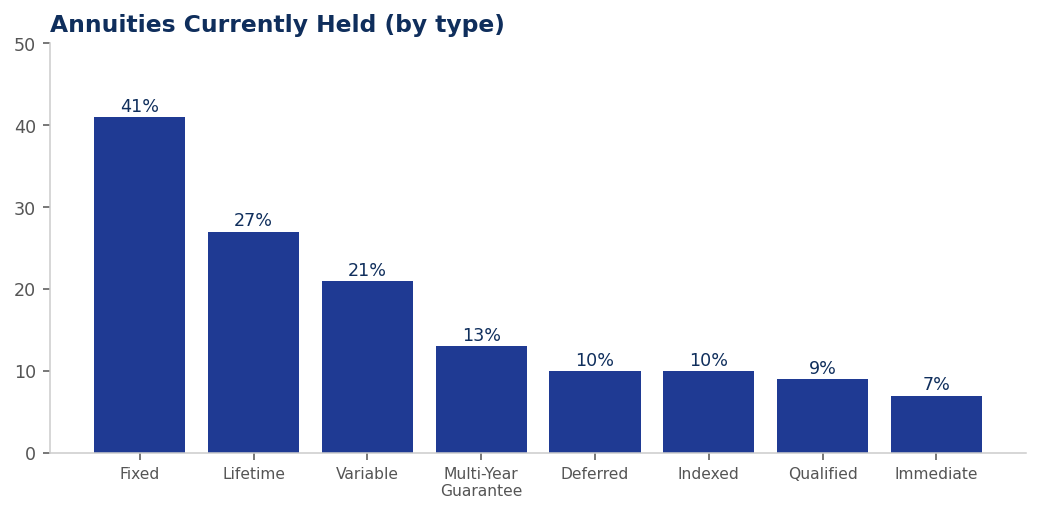
(Chart reconstructed from the article’s YouGov data for display in this redline.)
Source: YouGov [Alt text: YouGov chart showing the types of annuities people currently hold]
Digital-first annuities are helping remove the friction that once intimidated investors. They simplify disclosures by presenting contract terms in plain language, so buyers can grasp key features without wading through legal jargon. In addition, they streamline enrollment with intuitive online platforms that let buyers complete and submit forms in minutes.
When annuities are presented in clear terms, investors can quickly see how the products work and what they offer. This transparency turns what once felt confusing into a trusted, practical tool for retirement security.
How Gainbridge℠ describes its direct-to-consumer approach
Simplicity doesn’t happen by accident. It’s intentionally built into the customer experience. Gainbridge℠ embraces that approach through a direct-to-consumer model that removes the friction points investors associate with annuities, including:
- Commission-based sales models
- Hidden fees or costs that are difficult to compare
- Paper-heavy onboarding and enrollment processes
- Limited transparency around contract details
- Uncertainty about where to turn for help
Our direct-to-consumer model makes it easy for you to buy an annuity directly through our website. Because contracts are sold through the platform rather than through commissioned intermediaries, a separate sales commission is not charged to the consumer. Applicable contract charges (including surrender charges during the surrender-charge period, any market-value adjustment, and any optional rider charges) are disclosed in the contract and product disclosure materials. That clarity matters. When costs are easy to see and compare, investors can avoid digging through the fine print.
Gainbridge℠’s digital-first platform also reflects survey findings that many consumers are comfortable purchasing financial products online. Nearly 68% of consumers say they’re comfortable purchasing financial products directly from provider websites. This indicates a strong trend toward self-directed investing. Gainbridge℠ meets that expectation with a streamlined user experience that replaces paper-based processes and prioritizes clear disclosures and account details. (YouGov, Financial Confidence & Independence, Jan 17, 2025)
At the same time, consumers are not required to purchase without assistance. U.S.-based agents licensed as insurance producers in the applicable state are available by phone to answer product questions.
By pairing transparent pricing with digital accessibility and human support, Gainbridge℠ helps investors feel more comfortable and ready to take control of their financial future.
Learn more about Gainbridge℠ annuity products
Simplicity shapes how people invest. When investors clearly see how a product works, what it costs, and what to expect, hesitation fades and trust forms faster. That’s a big deal in an industry where complexity is often mistaken for sophistication.
Today’s no-fuss planner isn’t asking for endless options or elaborate optimization strategies. They want predictable outcomes and products that respect their time and attention. Companies that remove friction through transparent pricing and ongoing education earn stronger consideration and lasting loyalty.
That’s where Gainbridge℠ shines. Our direct-to-consumer, digital-first experience helps investors make decisions without pressure or guesswork.
When information is clear and easy to follow, simplicity strengthens trust and builds confidence over time.
Explore Gainbridge℠ today to see how our annuities can support your retirement-income objectives, subject to product availability in your state and the terms of the annuity contract.
This article is for informational purposes only. It is not intended to provide, and should not be interpreted as, individualized investment, legal, or tax advice. The Gainbridge℠® digital platform provides informational and educational resources intended only for self-directed purposes.
Sources
- CBS News, Personal finance advice doesn't work for most Americans, economists say, December 2, 2025
- Investopedia, Why annuities are growing in popularity, June 10, 2025
- Policygenius, Annuities Literacy Survey 2024, July 16, 2024
- RFI Global, From debt to deposits: How US households are responding to rates, July 7, 2025
- ScienceDirect, Complexity aversion in risky choices and valuations: Moderators and possible causes, January 2024
- YouGov, Financial Confidence & Independence, Jan 17, 2025
Annuities are insurance products. They are NOT bank deposits, NOT FDIC- or NCUA-insured, NOT insured by any federal government agency, and NOT guaranteed by any bank or credit union. Annuity guarantees are backed solely by the financial strength and claims-paying ability of the issuing insurance company. This article compares consumer perceptions of certificates of deposit and annuities; the two products are not equivalent and should not be treated as substitutes for one another.
Fixed and multi-year guarantee annuities generally include surrender charges for withdrawals during the surrender-charge period, may include market-value adjustments, and may include charges for optional riders. Please review the annuity contract, disclosure statement, and any state-required buyer’s guide for a complete description of fees, charges, and limitations.
Withdrawals of taxable amounts from an annuity are subject to ordinary income tax and, if taken before age 59½. Consult a qualified tax professional regarding your situation.
Statistics attributed to YouGov are drawn from the “Financial Confidence & Independence” study fielded January 2025 (n = 3,035 U.S. adults). Underlying survey data are maintained on file.





.jpg)