
The cash confidence crisis begins with a clear disconnect. On the surface, Americans feel capable of managing their money. But their actions show hesitation and uncertainty.
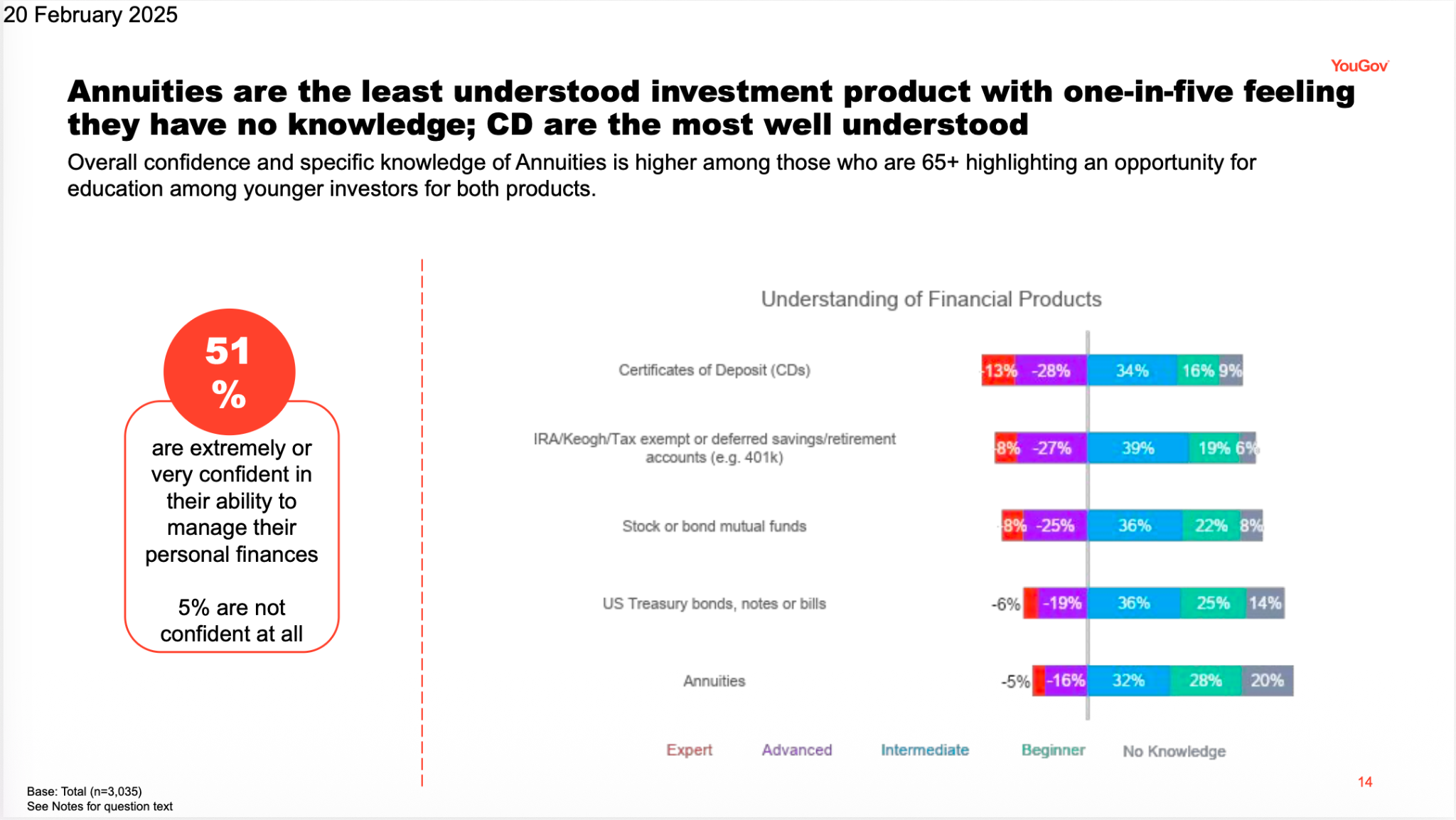
Research shows more than half (51%) of Americans say they’re very or extremely confident in financial management, while just 5% report no confidence at all. (YouGov, Financial Confidence & Independence, Jan 17, 2025)
Source: YouGov
But that confidence isn’t translating to strategic financial moves. Instead, many Americans default to defense mode, actively paying down debt (49%) and building cash reserves as their first line of security. (LendingTree, Nearly 1 in 5 Americans Ended 2025 Worse Off, Jan 26, 2026)
Economic uncertainty fuels this behavior. Americans are stressed about rising gas prices and the overall direction of the economy. (CBS News, Stress, uncertainty as economy views decline, CBS News poll finds, May 17, 2026)
This uncertainty is the top barrier to reaching financial goals. It shapes how people manage both their everyday finances and long-term plans. Millions of Americans respond to economic pressures by relying on basic savings accounts to reduce risk. (NerdWallet, 2025 Savings Report, April 8, 2025)
As uncertainty rises, people gravitate toward financial choices that feel simple and within their control. Cash and basic savings accounts offer that sense of immediacy and flexibility. There’s no long-term commitment or fear of making the “wrong” move in an unpredictable economy.
This preference for clarity and easy-to-understand solutions explains why many hesitate to explore more structured financial products, even when they feel confident managing day-to-day money. That’s why many skip annuities — one of the least understood options — not because they reject them outright, but because the lack of clarity makes them feel complicated. In contrast, cash feels more manageable and gives a sense of control. (YouGov, Financial Confidence & Independence, Jan 17, 2025)
This mindset mirrors the “no-fuss planner” persona, one that’s practical and drawn to simplicity. These investors make intentional choices, prioritizing flexibility and predictability, especially when the economic environment feels unstable.
Still, that same cautious approach may lead them to overlook products that offer different tradeoffs than cash, including more predictable income in exchange for reduced liquidity.
Why cash feels safer than investing
Market volatility often pushes investors to play it safe. Long-term investments feel risky because they involve market swings and often require committing your money for years. This limits how easily you can access money when unexpected needs come up.
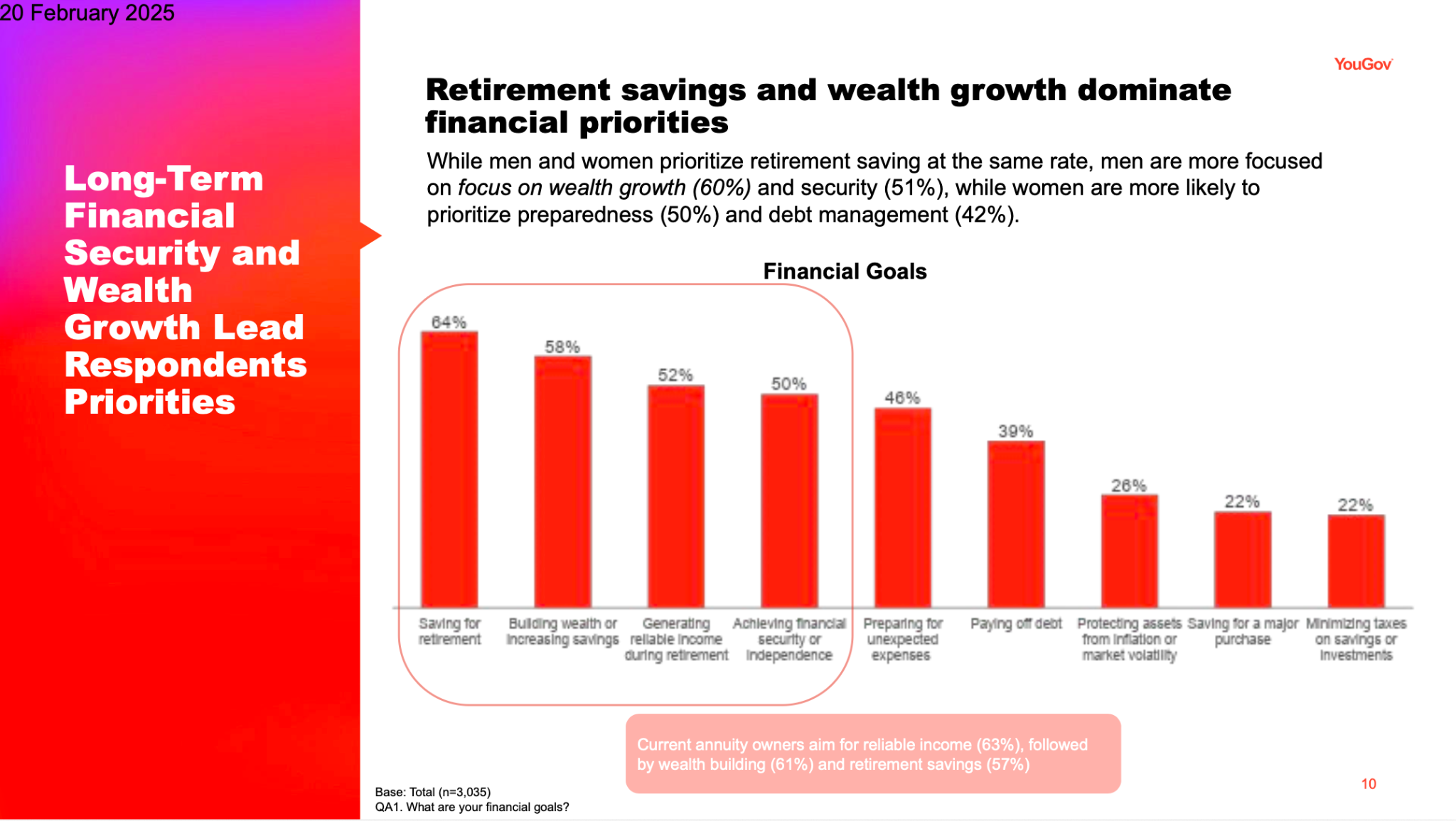
During times of economic uncertainty, people are even more inclined to move toward risk-averse strategies, like boosting cash reserves. Money held in savings accounts feels flexible and immediate: You can easily deposit and withdraw it when needed. This creates a sense of control compared to the uncertainty of investing in the stock market.
Holding cash involves a tradeoff: it preserves liquidity but its purchasing power can erode with inflation over time. (YouGov, Financial Confidence & Independence, Jan 17, 2025)
Source: YouGov
Despite wanting long-term stability, many end up opting for short-term safety. The immediate peace of mind cash provides often outweighs the appeal of investments that could offer more growth.
The complexity barrier: When “too much information” becomes inaction
Complexity can freeze investors in their tracks. Nearly 6 in 10 Americans (59%) report walking away from a financial product that felt too complicated. (YouGov, Financial Confidence & Independence, Jan 17, 2025)
Too often, complexity signals hidden fees or aggressive sales pressure, and that perception alone can stop people from exploring further. In a 2024 survey, Gartner found that consumers increasingly associate unexpected price changes, hidden fees, and similar pricing practices with distrust. (Gartner, Survey Finds 68% of Consumers Report They Feel Taken Advantage of When Brands Use Dynamic Pricing, Dec 16, 2024)
Research doesn’t always help, as digging deeper into financial tools can overwhelm consumers and make products seem time-consuming and expertise-heavy. Gaining more knowledge rarely increases confidence, but reinforces a sense of confusion. (CBS News, Personal finance advice doesn't work for most Americans, economists say, December 2, 2025)
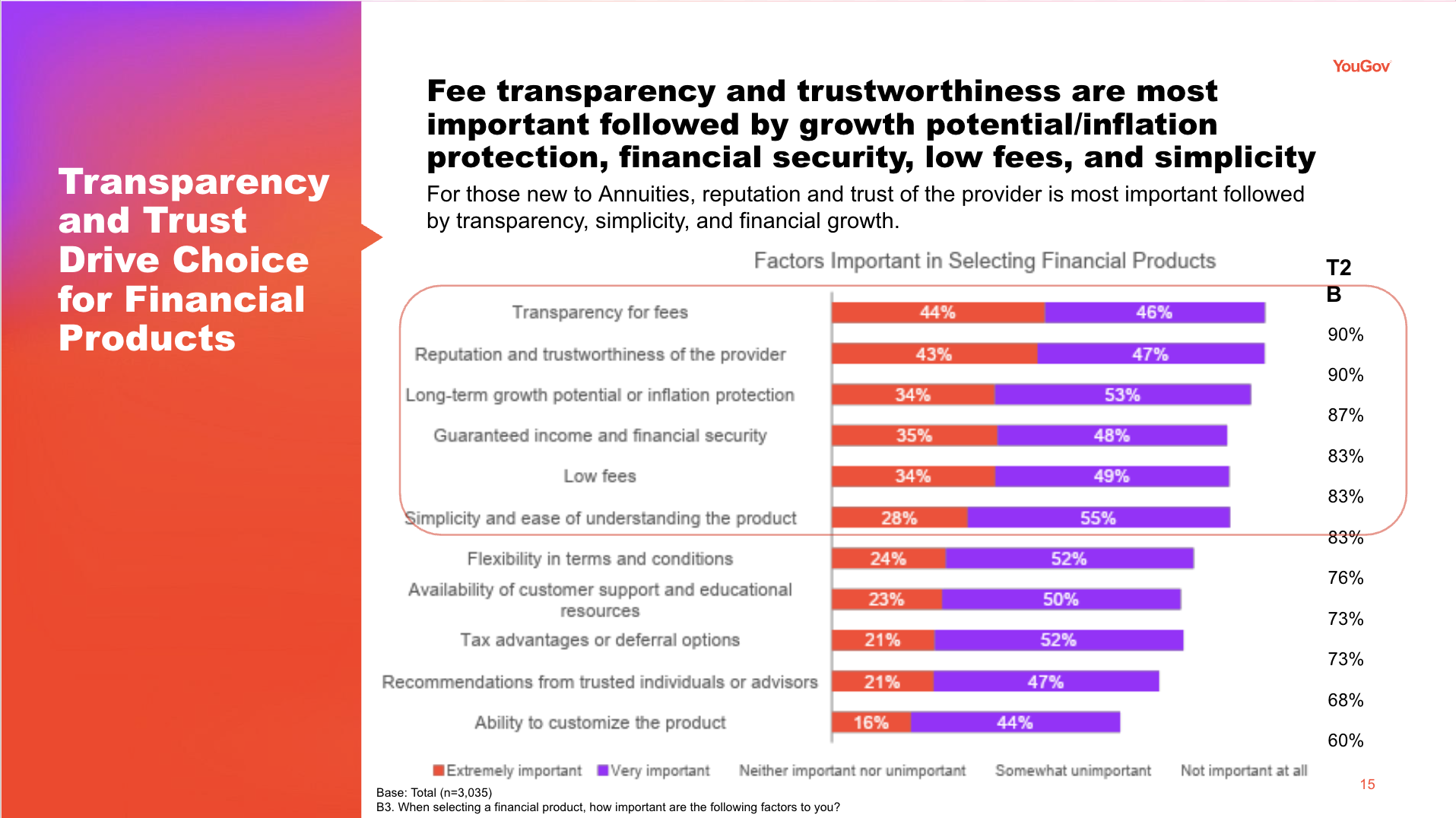
For self-directed investors, especially the no-fuss planner, the perceived research burden becomes a barrier rather than a motivator. They gravitate toward products with upfront fees, risks, and benefits clearly stated. Trust and transparency drive their decisions, while obscurity pushes them away.
Source: YouGov
Annuities highlight how this plays out. Consumers often dismiss them early, labeling them as complex or hard to evaluate. For investors who favor low-maintenance strategies, anything unclear or opaque is effectively off-limits. (YouGov, Financial Confidence & Independence, Jan 17, 2025)
When stability is needed most (but rarely chosen)
Life changes make retirement security feel urgent. Job transitions, family milestones, or sudden expenses like large medical bills can all prompt consumers to reassess their finances. (Forbes, How Financial Services Brands Can Support Consumers During Important Life Events, Dec 9, 2025)
But even in these moments, many Americans stick to comfortable strategies instead of exploring structured options like annuities. Research shows that:
- Cash and debt take priority: Most consumers respond to life events by increasing cash reserves or paying down debt — moves that are immediate and controllable.
- Perception impacts behavior: Many investors avoid structured products because they appear too involved or difficult to access.
These attitudes and behaviors reflect the no-fuss planner. This persona reacts pragmatically to change but defaults to familiar actions. Despite their desire for stability, comfort and clarity guide their choices. (YouGov, Financial Confidence & Independence, Jan 17, 2025)
What investors actually want
Today’s consumers want straightforward solutions, and the no-fuss planner embodies this mindset. They seek tools that let them research and act on their own terms, free from pushy sales tactics. (YouGov, Financial Confidence & Independence, Jan 17, 2025)
Today’s investors are in the market for:
- Clear explanations of trade-offs: They want to know what they’re gaining and what they’re giving up with every decision.
- Transparent fee structures: They want to avoid hidden charges that reduce trust.
- Tools that complement cash: They want investments to feel like a natural extension of cash, not a replacement for it.
- Predictable outcomes: They want steady results rather than aggressive growth.
- Digital access: They want control at their fingertips, with the ability to make decisions independently.
For the no-fuss planner, these priorities influence how they manage money. They pick simple tools that fit naturally into their routines and work alongside their cash reserves.
The overlooked middle ground: Annuities as structured stability
Too often, annuities are misunderstood before consumers ever evaluate what they offer. Survey research indicates a substantial share of consumers view annuities as complex, and a further share cite fees and costs as a deterrent. Confirm the exact percentages and survey date before publication. (YouGov, Financial Confidence & Independence, Jan 17, 2025)
Fixed annuities credit a guaranteed interest rate for a stated term and can provide scheduled payments later. Fixed indexed annuities credit interest using a formula tied to a market index, subject to caps, participation rates and spreads; a negative index result generally produces a 0% credit rather than a loss of contract value. Unlike cash, annuity funds are subject to surrender charges and any market value adjustment on early withdrawal.
Modern, digital-first annuities are designed to close this perception gap through simplified disclosures, clearer benefits explanations, and streamlined enrollment flows. By presenting key features in transparent and digestible formats, digital-first providers make annuities easier to evaluate.
Annuities occupy a different position than either cash or equities. Fixed annuities offer a known crediting rate in exchange for committing funds for the contract term. Fixed and fixed index annuities can also reduce exposure to market volatility since they’re not directly invested in the stock market. Contracts include guaranteed minimum values, and any guarantees depend on the claims-paying ability of the issuing insurance company.
Compared with equities, these contracts offer more predictable crediting and less market exposure, in exchange for capped growth and reduced liquidity.
How Gainbridge℠ approaches financial certainty
Gainbridge℠ uses a direct-to-consumer model, so purchases are made online rather than through an agent. Instead of going through a sales agent, consumers have a chance to purchase online when it’s convenient for them. This approach offers more control over the pace and direction of their financial decisions.
No sales commissions are charged and there is no annual contract fee; product costs are reflected in the rate credited. Surrender charges and any market value adjustment apply as described in the contract.
Education plays a central role. Gainbridge℠'s self-serve tools and content let you research and act on your own timeline.
Simplicity is behind every part of the Gainbridge℠ platform. The platform is designed to present product terms clearly. For today’s consumers, especially those who value clarity and control, Gainbridge℠ helps you take charge of your financial strategy and make the most of retirement planning.
The opportunity ahead: From cash-heavy caution to confident stability
Right now, millions of Americans are sitting on the sidelines, holding onto cash in response to economic uncertainty. Cash preserves liquidity, but its purchasing power can erode with inflation.
The path forward starts with education and simplification. When investors understand how a product works, what it costs, and what to expect, they’re far more likely to engage. Brands that clarify their offerings earn trust and stand out from the rest.
Gainbridge℠ combines clear product disclosure with a digital-first purchase process.
Get started with Gainbridge℠
The cash confidence crisis stems from uncertainty in a complex economic environment. Americans are taking care to navigate financial decisions carefully and look for options that keep them in control. When financial tools remove friction instead of adding to it, people feel more comfortable taking the next step.
Check out Gainbridge℠ for stability-focused solutions that give you simplicity and predictability as you’re saving for retirement or preparing for your next milestone.
This article is for informational purposes only. It is not intended to provide, and should not be interpreted as, individualized investment, legal, or tax advice. The Gainbridge℠ digital platform provides informational and educational resources intended only for self-directed purposes.
Sources
CBS News, Personal finance advice doesn't work for most Americans, economists say, December 2, 2025 [https://www.cbsnews.com/news/retirement-personal-finance-advice-too-complex-economists-fixed/]
CBS News, Stress, uncertainty as economy views decline, May 17, 2026 [https://www.cbsnews.com/news/cbs-news-poll-stress-uncertainty-economy-views-decline/]
Forbes, How Financial Services Brands Can Support Consumers During Important Life Events, Dec 9, 2025 [https://www.forbes.com/sites/amazon-ads/2025/12/05/how-financial-services-brands-can-support-consumers-during-important-life-events/]
Gartner, Survey Finds 68% of Consumers Report They Feel Taken Advantage of When Brands Use Dynamic Pricing, Dec 16, 2024 [https://www.gartner.com/en/newsroom/press-releases/2024-12-16-gartner-marketing-survey-finds-68-percent-of-consumers-report-they-feel-taken-advantage-of-when-brands-use-dynamic-pricing]
LendingTree, Nearly 1 in 5 Americans Ended 2025 Worse Off, Jan 26, 2026 [https://www.lendingtree.com/debt-consolidation/financial-outlook-survey/]
NerdWallet, 2025 Savings Report, April 8, 2025 [https://www.nerdwallet.com/banking/studies/2025-savings-report]
YouGov, Financial Confidence & Independence, Jan 17, 2025