TAX-DEFERRED
Grow now, pay later
Your interest isn't taxed until you withdraw it, so your money grows without an annual tax bill along the way.
Lock in a fixed interest rate between ${RATE_RM_RANGE}¹, no matter what the market does. Rate varies by term length and the total amount you deposit into your account. No more surprises to worry about during retirement.

Retirement Flex is a fixed rate flexible premium deferred annuity you open online, built for retirement savings. Lock the money you want at guaranteed rates for the terms you select¹, and whatever you don't lock still earns interest in your Cash Wallet. Growth is tax-deferred, so you don't pay tax on your interest until you withdraw.
Move money over from an IRA, 401(k), or Roth account, or start with new savings. Add money anytime, no new application. Do it yourself, and call us if you want.
Unlike a CD, one account can hold as many terms as you want, each with its own rate and end date, so you never have to reapply just to add money.

If you want the predictability of a fixed interest rate while maintaining tax deferral, Retirement Flex could be a good fit for rolling over your existing IRA or 401(k).
Your interest isn't taxed while it's growing. You only pay tax when you actually withdraw, so your money keeps compounding without an annual tax bill chipping away at it.
One account can hold as many terms as you want, each with its own rate and end date. Split your money across shorter and longer terms so some of it comes available sooner, without reapplying every time.

| Under $100k | $100k and over | |
|---|---|---|
| 1 year | ${RATE_RM_1YR_LOW}${RATE_RM_1YR_CA_LOW} | ${RATE_RM_1YR_HIGH}${RATE_RM_1YR_CA_HIGH} |
| 2 years | ${RATE_RM_2YR_LOW}${RATE_RM_2YR_CA_LOW} | ${RATE_RM_2YR_HIGH}${RATE_RM_2YR_CA_HIGH} |
| 3 - 4 years | ${RATE_RM_3YR_LOW}${RATE_RM_3YR_CA_LOW} | ${RATE_RM_3YR_HIGH}${RATE_RM_3YR_CA_HIGH} |
| 5 - 6 years | ${RATE_RM_5YR_LOW}${RATE_RM_5YR_CA_LOW} | ${RATE_RM_5YR_HIGH}${RATE_RM_5YR_CA_HIGH} |
| 7 - 9 years | ${RATE_RM_7YR_LOW}${RATE_RM_7YR_CA_LOW} | ${RATE_RM_7YR_HIGH}${RATE_RM_7YR_CA_HIGH} |
| 10 years | ${RATE_RM_10YR_LOW}${RATE_RM_10YR_CA_LOW} | ${RATE_RM_10YR_HIGH}${RATE_RM_10YR_CA_HIGH} |
Put money in. Watch it grow. Get to your Cash Wallet anytime.
Select your term length and see your rate upfront. Know exactly what you're
locking in.
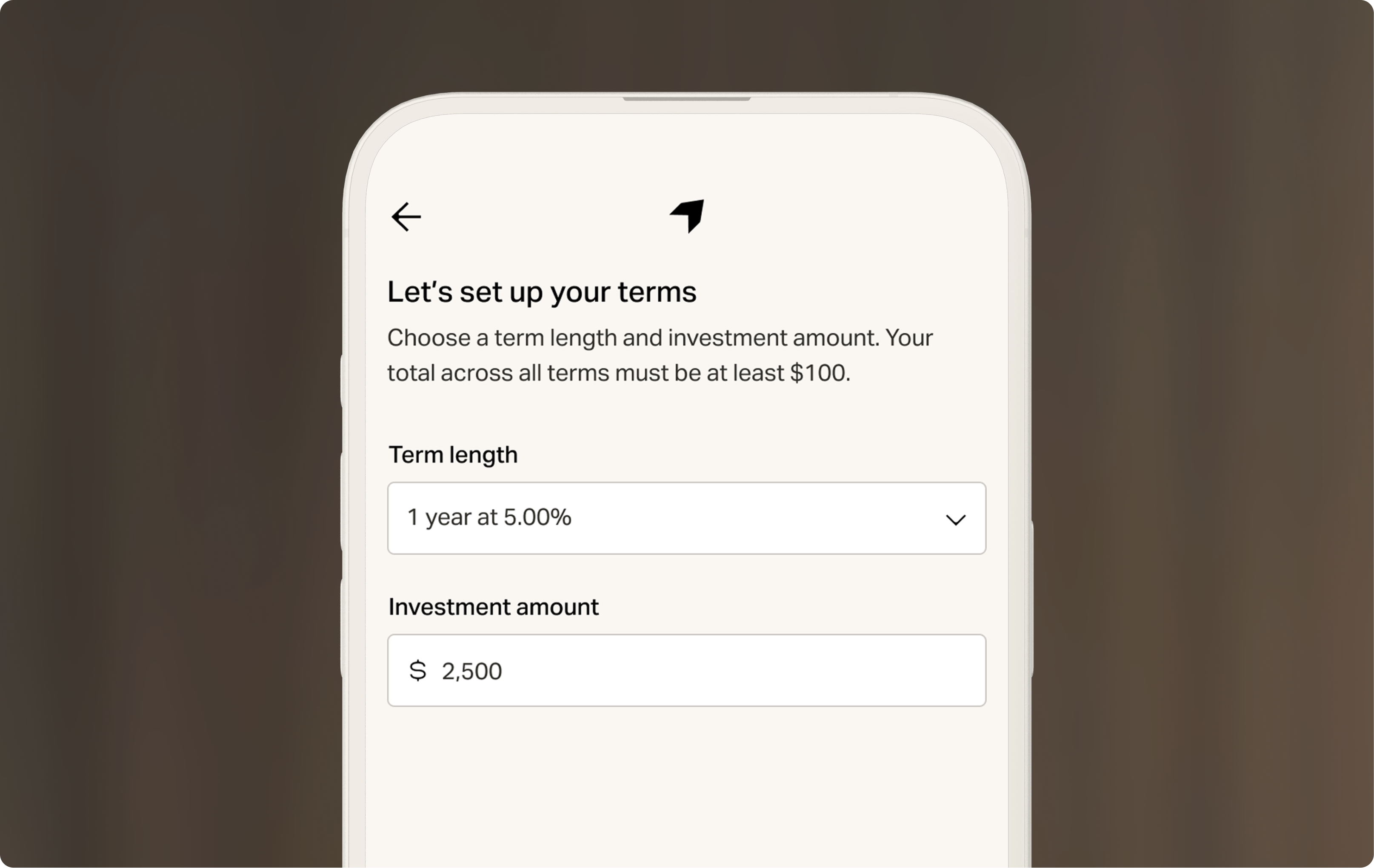
Split a deposit between locked terms and your Cash Wallet. Add more to your account anytime, no application.
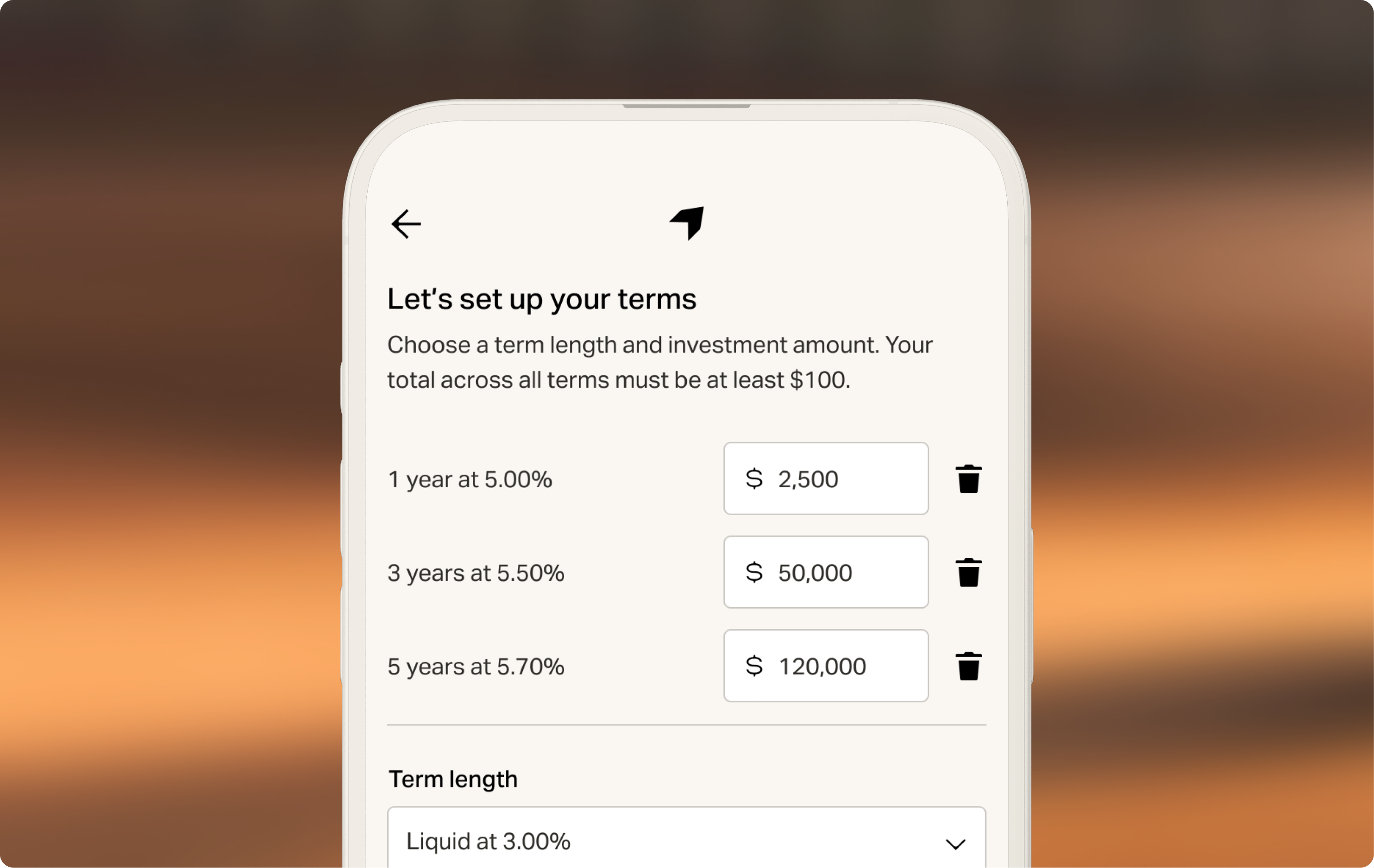
Lock in a rate for each term you choose¹⁵, then check in anytime to watch it grow toward that term's end.

Here are just a few reasons people love Gainbridge.
Have questions about our products or your account? Fill out the form, and one of our expert team members would love to help you.
Quick answers to get you started. Visit our full FAQ page for more.
Retirement Flex may be a good fit if you want tax-deferred growth without committing everything as a single lump sum, you're moving money over from an existing 401(k), IRA, or annuity, or you like laddering terms — which also helps later when you're taking required withdrawals. It's not limited to strictly ”qualified” avings either. You can open a Non-Qualified Retirement Flex account with after-tax savings from a bank account, or move over funds from an existing non-qualified annuity or a 1035 exchange.
A direct rollover (or, between IRAs,,a trustee-to-trustee transfer) typically avoids triggering tax. If the money is paid to you instead, your plan may withhold 20%, and any amount you don’t deposit within 60 days may be taxable, plus a possible 10% IRS tax penalty if your under age 59 ½.Confirm the specifics with a tax advisor before you move anything.
You can move money in from a Traditional IRA, SEP IRA, 401(k), or 403(b), which lands in a Retirement Flex account registered as a Traditional IRA. Roth money (Roth IRA or Roth 401(k)) goes into a Roth IRA-type Retirement Flex account.
Note: most employer 401(k) and 403(b) plans only allow you to roll money out after you've separated from that employer (some allow in-service rollovers, often starting at age 59½). Check with your plan administrator on your specific plan's rules.
A direct, trustee-to-trustee transfer typically avoids triggering tax. Confirm the specifics with a tax advisor before you move anything.
It depends on which type of Retirement Flex account you have. In all cases, “growth” below means the interest your money earns over time — separate from the amount you originally deposited.
Which of these actually applies to you depends on your specific situation, so it’s worth confirming with a tax advisor. Withdrawals of taxable amounts from Retirement Flex are subject to ordinary income tax and, if taken before age 59½, may be subject to a 10% federal income tax penalty.
If it's a Traditional IRA-style account, yes — current law requires you to start Required Minimum Distributions (RMD) at 73 if you were born 1951–1959, or 75 if you were born in 1960 or later. If you were born before 1951, your RMDs have likely already started. Roth IRA-style accounts don't have this requirement during your lifetime. If RMD timing is on your mind, you may want to consider shorter terms that mature around when your RMDs start, so you're not forced to break one early. RMDs continue every year thereafter, but you can generally take the total required from all your IRAs.
Yes, but know the tradeoffs. Traditional IRA-style withdrawals are taxed as ordinary income on the full amount. Non-Qualified withdrawals are taxed as ordinary income on the growth portion only (your original contributions aren’t; that money was already taxed), and withdrawals are generally treated as coming from growth first. Withdrawing from either account type before 59½ may add a 10% IRS penalty on the taxable portion. Pulling money out before a term ends can add a surrender charge on top of that.
Roth contributions — the money you put in — can come out anytime, tax-free and penalty-free. The growth is different: it generally only comes out tax-free and penalty-free if you’re age 59½ or older and at least 5 years have passed since you first contributed to any Roth IRA. Take out growth before meeting both of those, and you can owe income tax and the 10% penalty, same as early growth from a Non-Qualified account. If you’re already 59½, the penalty doesn’t apply, only the income tax. Money you converted from pre-tax savings has its own rule: if you’re under age 59½, you may owe the 10% IRS penalty if you withdraw it within 5 years of conversion. Surrender charges or a market value adjustment can apply to a Roth withdrawal before the end of a term, too.
9 Min read
Not sure about investing in an annuity? Read through the pros and cons of annuities to decide whether these products suit your financial plan.

8 Min read
New generations aren’t buying annuities like their parents, and their expectations are reshaping the market. Read Gainbridge's report on the shift to modern solutions.

.webp)